

Choosing a fragrance for an air freshener may begin with something simple: a familiar scent such as vanilla, sandalwood, leather or new car, a reference sample, or an entirely new fragrance idea.
But in manufacturing, choosing a scent is only the beginning. The fragrance also needs to fit the product format, target market and intended release performance before it can become a production-ready air freshener.

Start with the Scent Direction
A fragrance project does not need to begin with a complete formula. Buyers can start with a familiar scent direction, an existing fragrance reference, or a description of the character they want the finished product to have. For example, terms such as bergamot, sandalwood, vanilla, leather or new car scent can provide a useful starting point for development.
However, a scent name is not a finished fragrance specification. Two fragrances described as “sandalwood” or “new car” can smell noticeably different depending on their composition, balance and overall fragrance profile. The development brief therefore needs to define more than the category name itself.
The clearer the initial direction, the easier it is to narrow down suitable fragrance options or develop a custom scent. Useful references may include a physical sample, a target fragrance profile, preferred notes, fragrances to avoid, or a description of how the scent should feel—for example fresh, dry, warm, clean or woody. This creates a more practical starting point for sampling and further adjustment.
Consider Your Target Market and Product Positioning
The same fragrance direction can work very differently depending on who the product is designed for and where it will be sold. The goal is not to follow a generic list of “popular scents,” but to choose a direction that fits the intended customer, use environment and product positioning.
Before selecting samples, it helps to define several parts of the market context. These inputs do not determine the fragrance automatically, but they give the development process a clearer direction.
| Market Input | What to Define | Why It Matters for Fragrance Development |
|---|---|---|
| Target Market | Country, region or sales market | Helps narrow fragrance direction and evaluate market suitability. |
| Target Customer | Intended consumer group and product expectations | Influences the overall scent character and intensity. |
| Product Positioning | Everyday, premium, automotive, lifestyle, etc. | Helps align the fragrance profile with the intended product experience. |
| Use Environment | Vehicle, home, office or other enclosed space | Affects expectations for scent strength and release performance. |
| Usage Conditions | Temperature variation, airflow and typical use pattern | Can affect how the fragrance performs after it is placed in the final product. |
| Brand Direction | Fresh, clean, woody, warm, sporty, elegant, etc. | Provides a more specific brief than relying on a scent name alone. |
For a custom air freshener project, this information turns a broad preference such as “we want a woody scent” into a more useful development brief. Once the intended market and product experience are clearer, fragrance samples can be evaluated against a defined target rather than personal preference alone.
Match the Fragrance to the Air Freshener Format
A fragrance does not perform independently from the product that carries and releases it. Once a scent direction has been selected, the next question is how that fragrance will behave inside the intended air freshener format. The carrier material, exposed surface, airflow and release structure can all change how quickly the fragrance is perceived and how its performance develops over time.
For this reason, a fragrance that works well in one format should not automatically be expected to behave the same way in another. A fragrance evaluated on a scent strip, for example, may produce a different experience once it is absorbed into paper, exposed to vehicle airflow through a vent clip, or released gradually through a membrane.
| Air Freshener Format | Main Release System | What Should Be Considered |
|---|---|---|
| Paper Air Freshener | Absorbent substrate + exposed surface | Fragrance absorption, surface area, initial release and evaporation rate. |
| Vent Clip Air Freshener | Fragrance carrier + airflow | Airflow, release area, cabin temperature and carrier performance. |
| Hanging Bottle Air Freshener | Liquid fragrance + wick / cap system | Wicking rate, evaporation, closure design and leakage control. |
| Membrane Air Freshener | Fragrance reservoir + membrane diffusion | Membrane permeability, controlled release and material compatibility. |
| Gel Air Freshener | Gel matrix + exposed area | Fragrance distribution within the gel and evaporation through the exposed surface. |
This means fragrance selection and product development should not be treated as two separate decisions. The scent direction may stay the same, but the fragrance system may need to be evaluated or adjusted for the way the final product stores and releases it.
Develop the Right Fragrance Release Profile
Once the fragrance direction and product format are defined, the next step is to evaluate how the scent should perform over time. A successful air freshener should not be judged only by how strong it smells when first opened. Its initial impact, release rate, scent character and useful life all contribute to the overall fragrance experience.
A common mistake is to treat fragrance strength and longevity as the same thing. A very strong opening can result from fragrance being released quickly, but that does not necessarily mean the product will remain noticeable for longer. Likewise, increasing fragrance loading alone does not guarantee a better-performing or longer-lasting air freshener. The release system still determines how that fragrance reaches the surrounding air.
Initial Scent Strength
The opening strength is the first impression after the product is activated or removed from its packaging. It should be noticeable enough for the intended use environment without making the initial release the only strong part of the product’s life.
Release Rate
Release rate determines how quickly fragrance moves from the product into the surrounding air. If it is too fast, the scent may begin strongly and decline quickly. If it is too slow, fragrance may remain in the product while the user perceives very little scent.
Fragrance Character Over Time
The fragrance itself can also change as it is released. Some notes are perceived more strongly at the beginning, while others become more noticeable later. Sample evaluation should therefore consider whether the fragrance remains recognizable and balanced over time, rather than judging it only from the first smell.
Longevity
Longevity is the result of the complete fragrance delivery system. Fragrance formulation and loading matter, but so do the carrier, exposed area, airflow, temperature and product structure. A long-lasting car scent, for example, depends on controlling how fragrance is released under actual vehicle conditions—not simply adding more fragrance oil.
The development goal is therefore not maximum fragrance strength or the slowest possible release. It is a controlled release profile that delivers an appropriate scent experience throughout the intended product life.
Test and Approve the Fragrance Before Production
A fragrance should be evaluated in the intended air freshener product before it is approved for production. Smelling the fragrance on its own can confirm whether the scent direction is right, but it does not show how the fragrance will perform once combined with the actual carrier, release structure and use conditions.
Product samples should therefore be evaluated over time rather than only immediately after opening. The review can focus on several practical questions: Does the finished product still match the approved scent direction? Is the initial strength appropriate? Does the fragrance release consistently? Does the scent remain recognizable as the product is used? And does the product deliver an acceptable useful fragrance life?
If the result does not meet the intended target, the sample can be adjusted and evaluated again before final approval. In practice, fragrance development is often better treated as a short validation cycle:
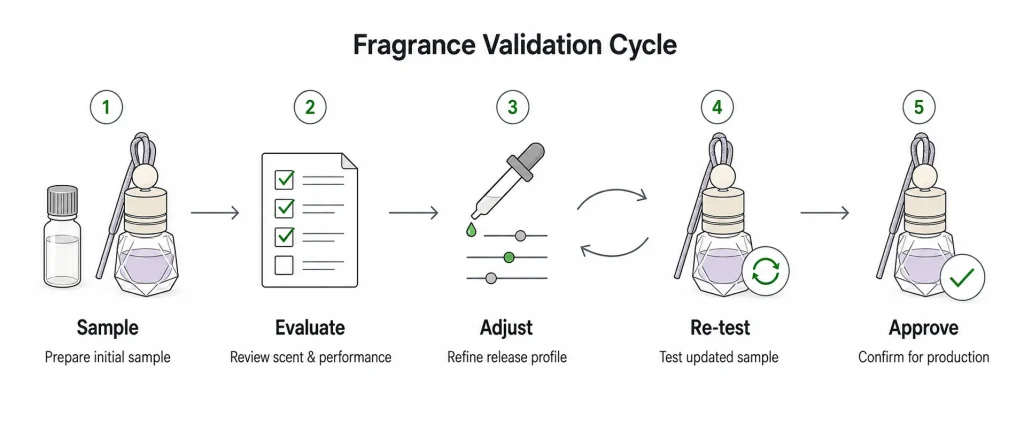
The important point is to approve the fragrance in the product, not only the fragrance itself. Once the scent character and product performance have both been confirmed, the approved sample can provide a clearer reference for production.
Move from an Approved Fragrance to Production
Once a fragrance has been approved in the final product format, the next step is to convert that approved sample into a clear production reference. At this stage, the goal is no longer to explore different scent directions, but to maintain consistency between the approved sample and future production batches.
This usually requires the fragrance and product requirements to be defined in a way that can be repeated during manufacturing. The approved sample becomes the reference point for fragrance character, product performance and overall acceptance. This helps reduce the risk of variation between development samples and finished production.
For buyers, the key takeaway is that fragrance approval should lead directly into production control. A fragrance is not fully ready simply because the scent has been selected. It is ready when the approved fragrance can be reproduced consistently as part of a custom air freshener product.
Choosing a fragrance for an air freshener is not simply a matter of selecting a scent that smells good. The fragrance also needs to fit the target market, product positioning, air freshener format and intended release profile.
A clearer development process starts with the scent direction, then moves through product compatibility, release performance, sample evaluation and final approval. Treating these decisions as part of one system makes it easier to develop a fragrance that works not only as a scent sample, but as part of the finished air freshener product.
If you are preparing a custom air freshener project, having a clear scent direction, target market and product format will make the first fragrance samples more useful and reduce unnecessary revisions during development.

