

A membrane air freshener releases fragrance through a polymer membrane instead of exposing the fragrance liquid directly to the air. The membrane helps control how fragrance moves out of the reservoir while keeping the liquid contained inside the product.
But the membrane alone does not determine how a product performs. Fragrance formulation, membrane properties, product structure, temperature, and airflow can all affect the actual release rate. This article explains how the system works and what controls its scent performance.

What Does the Membrane Actually Do?
At its most basic level, the membrane performs two connected functions: it allows fragrance components to move from the reservoir toward the surrounding air, while helping prevent the bulk fragrance liquid from flowing directly out of the product.
This controlled separation is what distinguishes a membrane air freshener from systems in which fragrance is directly exposed through an open container, absorbent material, or porous solid. If you are new to this product format, our guide to what a membrane air freshener is explains its basic structure and common applications.
It Controls How Fragrance Reaches the Air
Fragrance inside the reservoir does not simply evaporate freely into the environment. Before it can enter the surrounding air, fragrance components must first pass through the membrane.
The membrane therefore creates an additional transport barrier between the fragrance formulation and the outside environment. Depending on the membrane structure and material, fragrance can move through microscopic pores or through the polymer itself before reaching the outer surface and evaporating.
Because this transport takes time, the membrane can slow the release compared with direct exposure of the fragrance liquid. However, it should not be understood as a fixed “release timer.” Different fragrance molecules, membrane materials, temperatures, and product structures can all change the actual release rate.
It Helps Keep the Fragrance Liquid Contained
The second function is physical containment.
The membrane allows selected fragrance components to pass gradually while limiting the movement of the bulk liquid. This makes it possible to create compact products in which the fragrance reservoir can remain enclosed during normal use.
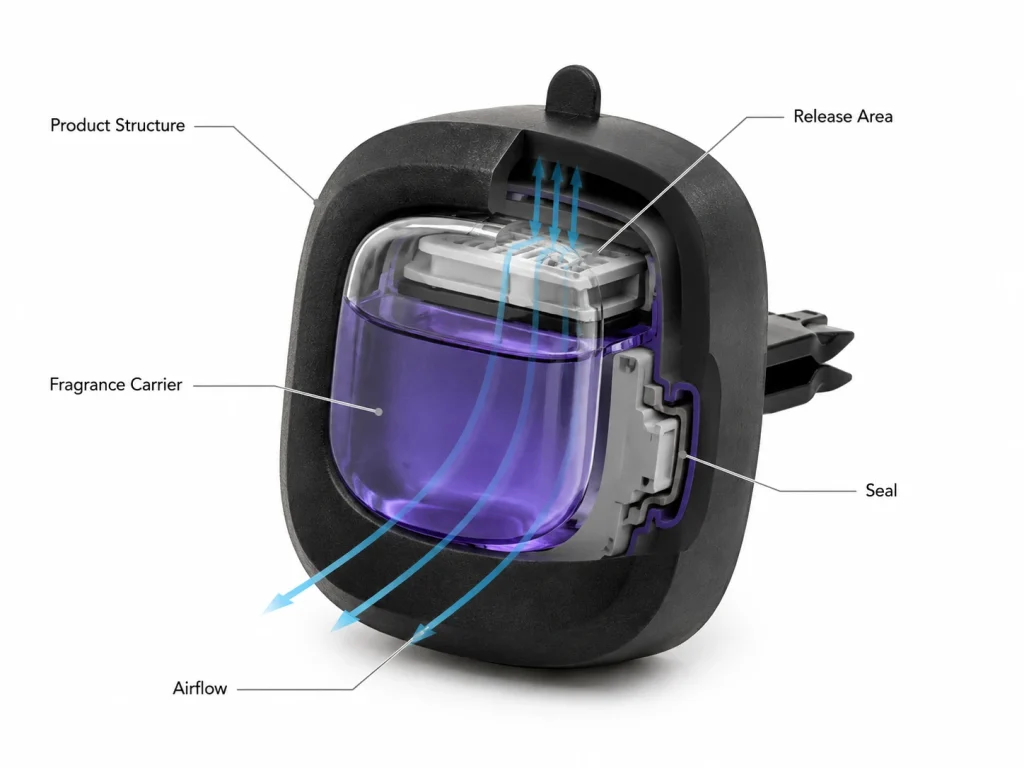
However, the membrane alone does not make a finished product automatically leak-proof. Actual leakage resistance also depends on how the membrane is sealed to the housing, the compatibility between the membrane and fragrance formulation, the reservoir design, manufacturing consistency, and the conditions the product experiences during storage and use.
For this reason, membrane performance should be considered together with the complete product structure rather than evaluated as an isolated material property.
How Fragrance Moves Through the Membrane
Fragrance does not pass through every membrane in exactly the same way. The transport mechanism depends on how the membrane is constructed and how the fragrance formulation interacts with the polymer.
In some products, the membrane contains very small pores. Fragrance components move through these microscopic pathways before reaching the outer surface and evaporating into the surrounding air. In other membrane systems, the material is non-porous. Instead of passing through physical holes, fragrance molecules dissolve into the polymer, diffuse through it, and then evaporate from the opposite side.
The practical result is similar: the membrane creates a controlled barrier between the liquid fragrance and the surrounding environment. But the release behavior can differ significantly depending on membrane thickness, polymer structure, permeability, and the fragrance itself.
This is why the membrane should not be treated simply as a piece of packaging film. Its structure is part of the fragrance-release mechanism and needs to be considered together with the formulation and the finished product design.
Why a Membrane Does Not Release Every Fragrance at the Same Rate
A fragrance is not a single substance. It is a mixture of many aroma compounds, and those compounds can behave differently when they interact with the same membrane.
Some molecules may move through the membrane relatively easily, while others may diffuse more slowly. Their volatility, molecular structure, polarity, and compatibility with the polymer can all influence how quickly they pass through the membrane and evaporate into the air.
As a result, two fragrances used with the same membrane can produce different release profiles. Even within one fragrance formula, individual components may not leave the reservoir at exactly the same rate.
This matters because changing the fragrance is not always a simple substitution. A membrane system developed around one fragrance formula may need to be re-evaluated when the formula changes, especially if the target is a specific scent strength or product lifetime.
For product development, membrane selection and fragrance development therefore need to be considered together rather than as two completely separate decisions.
What Controls the Release Rate?
The release rate of a membrane air freshener is not determined by the membrane alone. The most direct controls come from the membrane itself, the fragrance formulation, and the amount of membrane exposed. Environmental conditions and the overall product structure can then further influence how the system performs in actual use.
Membrane Properties
The membrane itself is one of the main controls on fragrance transport.
Its material, thickness, internal structure, and permeability can all influence how easily fragrance components move through it. A change in membrane construction can therefore produce a different release profile even when the same fragrance formula is used.
This is why membrane selection should be based on the intended release behavior rather than treated as a standard interchangeable component.

Fragrance Formulation
The fragrance formula has an equally important effect on release behavior.
Different aroma compounds vary in volatility and in how they interact with the membrane material. Some may pass through the membrane more readily than others, meaning that changing the fragrance formula can affect both the overall release rate and the balance of scent components reaching the air.
A membrane system that performs well with one fragrance may therefore need to be re-evaluated when a different formula is introduced.
Exposed Membrane Area
The effective membrane area exposed to the surrounding air provides another practical way to influence fragrance output.
A larger exposed area generally gives fragrance more surface through which to move and evaporate, while reducing the exposed area can help limit output. Product structure can therefore use membrane exposure as part of the balance between scent strength and target product life.
Temperature
Higher temperatures generally increase fragrance evaporation and can accelerate release. This is particularly relevant for automotive products, where cabin temperatures can vary substantially compared with normal indoor conditions.
Airflow
Air movement removes evaporated fragrance from the membrane surface. Stronger airflow can therefore increase the apparent fragrance output, which is especially relevant for membrane vent clip products positioned directly in front of a vehicle air vent.
Reservoir and Product Structure
Reservoir geometry, membrane position, fragrance contact, and the way the components are assembled can also affect finished-product performance.
These factors are usually evaluated together with the membrane and fragrance rather than treated as independent controls.
Why Membrane Air Fresheners Can Reduce Leakage
One of the practical advantages of a membrane system is that the fragrance liquid does not need to remain directly exposed to the outside environment.
The membrane acts as a barrier between the liquid reservoir and the surrounding air. Fragrance components can gradually pass through the membrane, while the bulk liquid remains contained inside the product. Compared with an open or directly exposed liquid system, this can reduce the risk of accidental spills during normal use.
However, leakage resistance does not depend on the membrane alone.
The membrane must be properly sealed to the surrounding housing, and both the membrane and sealing structure need to remain compatible with the fragrance formulation over time. If the fragrance causes swelling, softening, poor adhesion, or other material changes, the overall containment performance can be affected even if the membrane itself is functioning normally.
Product structure also matters. Reservoir geometry, sealing area, internal pressure, storage orientation, and temperature exposure can all influence how the finished product behaves.
For this reason, a membrane air freshener should not automatically be described as “leak-proof.” The more accurate approach is to evaluate leakage resistance at the finished-product level, including the membrane, fragrance, housing, sealing process, and expected conditions of use.
Does a Membrane Guarantee Consistent Scent from Start to Finish?
Not necessarily.
A membrane can help regulate fragrance release, but it does not automatically create a perfectly constant scent output throughout the entire product life.
A fragrance formula contains multiple aroma compounds, and these compounds do not all behave in the same way. As discussed earlier, some components may pass through the membrane more easily than others. At the same time, changes in temperature, airflow, remaining fragrance volume, and the condition of the membrane system can influence the release rate during use.
This means the scent perceived at the beginning of the product life may not be identical to the scent perceived near the end. A product may release fragrance more strongly during one period and more gradually during another, depending on how the complete system has been designed.
The role of the membrane is therefore better understood as release control, rather than a guarantee of perfectly uniform release.
For brands developing a membrane air freshener, the relevant question is not simply whether a membrane provides “long-lasting fragrance.” It is whether the membrane, fragrance formula, product structure, and intended use environment can work together to achieve an acceptable release profile over the target product life.
What Should Brands Consider When Developing a Membrane Air Freshener?
Developing a membrane air freshener is not simply a matter of selecting a membrane and filling the reservoir with fragrance. The membrane, fragrance formula, product structure, and intended use environment need to be evaluated as one system.
A practical development process usually starts with the target product performance: how strong the fragrance should feel, how long the product is expected to last, where it will be used, and what product format is being developed.
From there, several decisions need to work together.
Fragrance formula × membrane × exposed area
These three factors have the most direct influence on how fragrance moves through the system. Changing any one of them can alter scent strength, release profile, or expected product life.
Product structure × sealing
The membrane must also function reliably within the finished housing. Reservoir design, membrane position, sealing area, assembly method, and material compatibility all affect containment and production consistency.
Use environment × target lifetime
A product designed for a vehicle vent may experience airflow and temperature conditions very different from a hanging product or an indoor air freshener. The intended environment therefore needs to be considered when setting performance expectations.
For brands developing a new membrane air freshener, the most useful question is usually not:
“Which membrane should we use?”
It is:
“Which combination of fragrance, membrane, structure, and exposed area can achieve the required scent performance under the intended conditions of use?”
That combination should then be validated as a finished product rather than judged from the membrane specification alone.
A membrane air freshener works by controlling the movement of fragrance between an enclosed reservoir and the surrounding air. But the membrane is only one part of the system.
Actual performance depends on how the membrane interacts with the fragrance formula, how much membrane is exposed, how the reservoir and housing are designed, and the temperature and airflow the product experiences during use.
For product development, the goal is therefore not to find a membrane that is simply “long-lasting” or “leak-proof.” It is to build and validate a complete fragrance-delivery system that can achieve the required scent strength, product life, and containment performance under the intended conditions of use.

